Revisión bibliográfica
Martín Pérez R, Sáez Alcaide L M, Limones Burgos Á, Cendrero Martín M, Molinero Mourelle P, De Paz Hermoso V, López-Quiles J. Efi cacia de los concentrados plaquetarios en distracción ósea alveolar: una revisión de la bibliografía. Cient. Dent. 2021; 18; 1; 43-50
Eficacia de los concentrados plaquetarios en distracción ósea alveolar: una revisión de la bibliografía
Resumen
Introducción: La distracción ósea alveolar (DOA), es una técnica de aumento óseo predecible, con resultados exitosos a medio y largo plazo. El uso de concentrados plaquetarios (CP) ha demostrado ser benefi cioso en la cicatrización de tejidos blandos y la reparación y regeneración ósea, mediante liberación de factores de crecimiento. Se ha probado el uso de CP durante la distracción de huesos largos, obteniéndose resultados benefi ciosos.
El objetivo de esta revisión bibliográfi ca fue analizar los resultados clínicos de la combinación de la DOA y el uso de CP.
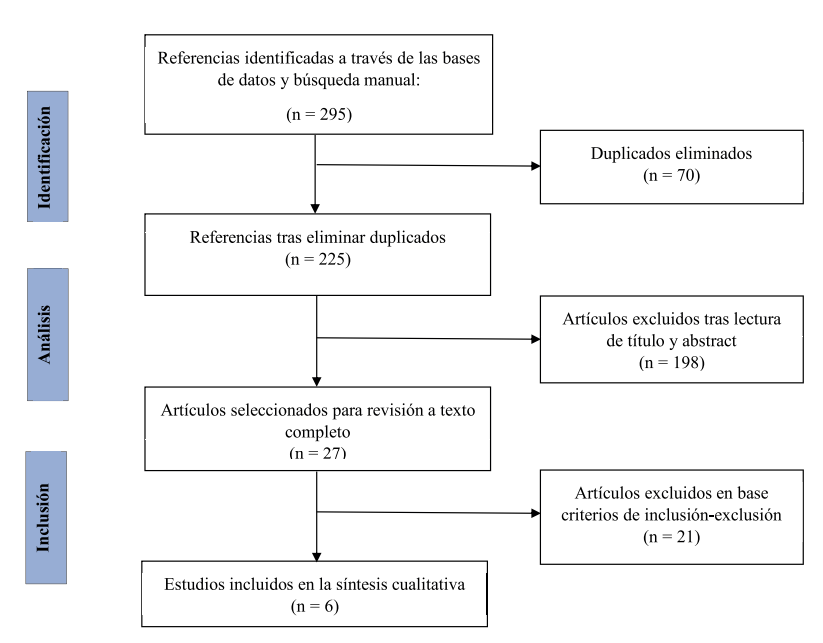
Material y método: Se realizó una revisión bibliográfi ca en tres bases de datos electrónicas sin restricciones. Además, la búsqueda electrónica fue completada con una manual, para identifi car cualquier artículo adicional de relevancia.
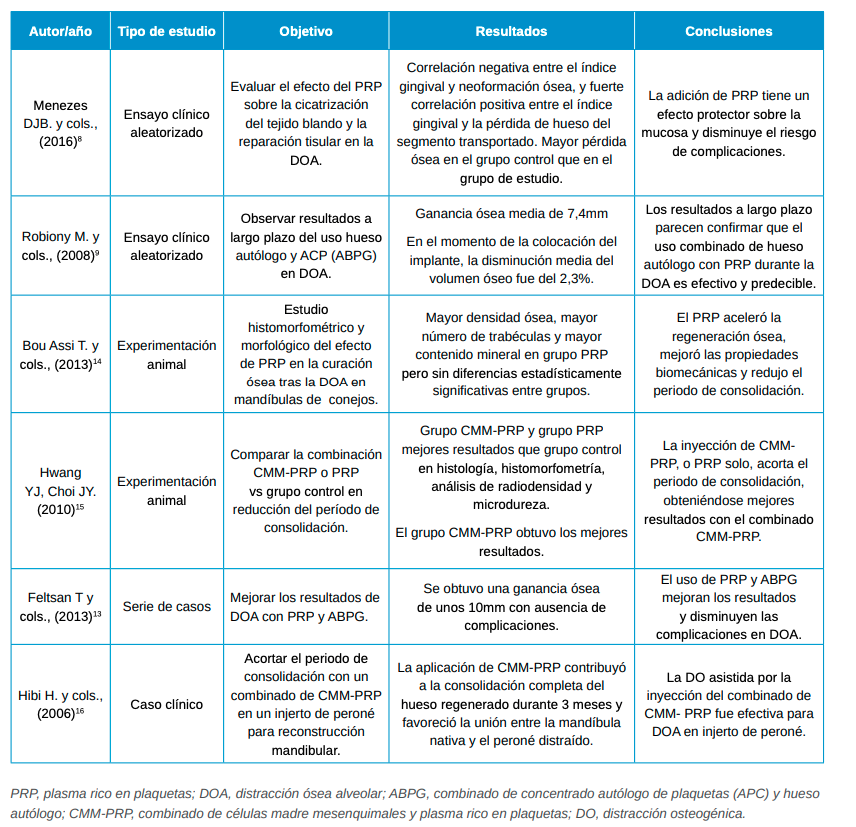
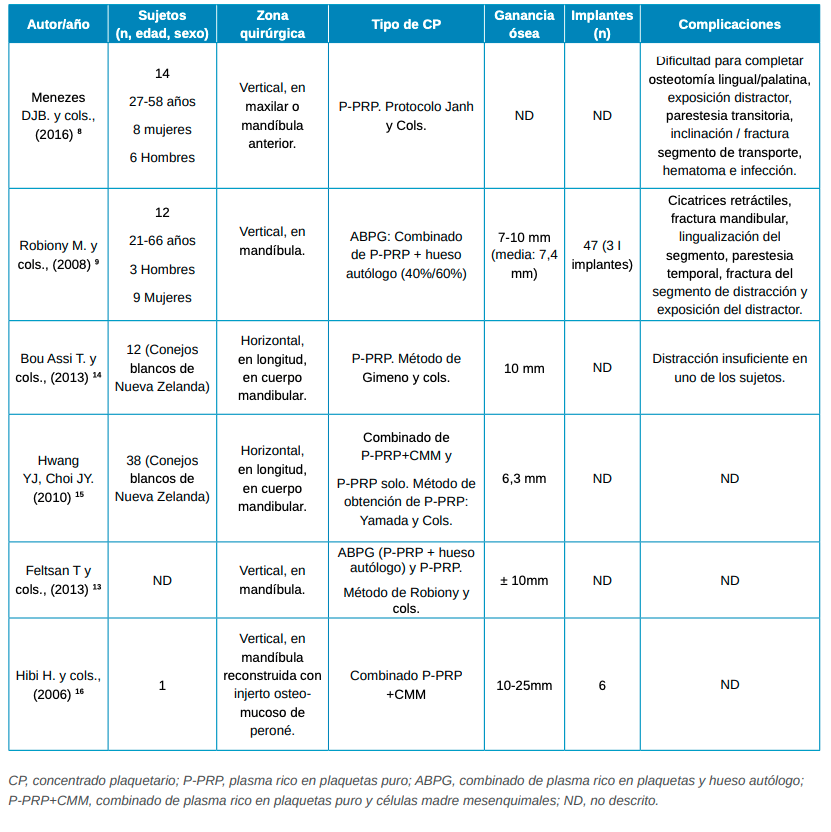
Resultados: Se seleccionaron 6 artículos; dos ensayos clínicos aleatorizados en humanos, dos estudios de experimentación animal y dos casos clínicos. Los artículos incluyeron un total de 27 pacientes y 50 conejos, y utilizaron diferentes protocolos para la obtención de CP. Se registraron ganancias óseas de entre 6,3 mm a 25 mm. Además, tres artículos reportaron complicaciones como parestesia transitoria, infección o inclinación del segmento de transporte.
Conclusiones: El uso de CP durante la DOA presenta efectos positivos, disminuir el riesgo de infección y la respuesta infl amatoria, aumentar la vascularización del callo de fractura, producir una aceleración en la regeneración ósea y disminuir el periodo de consolidación. Ante la heterogeneidad de los artículos incluidos, son necesarios más estudios que esclarezcan el papel de los CP y su infl uencia durante la DOA.
Abstract
Introduction: Alveolar distraction osteogenesis (ADO) is a predictable bone augmentation technique, with successful results in the medium and long term. The use of platelet concentrates (PC) has been demonstrated to be benefi cial in soft tissue healing, in bone repair and regeneration, through the release of growth factors. The use of PC has been used in combination with osteogenesis distraction of long bones, obtaining positive results.
The aim of this literature review was to analyze the clinical outcomes of the combination of the alveolar distraction technique and the use of PCs.
Material and methods: A bibliographic review was performed in three electronic databases without time or language restrictions. In addition, the electronic search was completed by a manual, to fi nd any additional relevant articles.
Results: 6 articles were selected; two human randomized clinical trials, two animal experimentation and two clinical cases. The articles included a total of 27 patients and 50 rabbits and used different protocols to obtain PCs. Bone gains of between 6.3mm to 25mm were reported. In addition, three articles reported complications such as transient paresthesia, infection, or inclination of the transport segment.
Conclusions: The use of PCs during ADO has positive effects, by decreasing the risk of infection and the infl ammatory response, enhancing the vascularization of the fracture callus, causing an acceleration in bone regeneration and reducing the consolidation period.
Due the heterogeneity of the articles included, more studies are needed to clarify the role of PCs and their influence during ADO.
Este artículo está exclusivamente disponible para su descarga en PDF. | 03/29/2024
Palabras clave
Concentrados plaquetarios, Distracción osteogénica alveolar, Factores de crecimiento
Introducción
La atrofia ósea severa de la cresta alveolar es uno de los retos que, cada vez con más frecuencia, se presenta en la rehabilitación del paciente mediante implantes dentales1 . Entre las técnicas más estudiadas y utilizadas para la regeneración y reconstrucción ósea, se encuentran, entre otras, los injertos en bloque, la distracción ósea alveolar (DOA) y las técnicas de regeneración ósea guiada (ROG)2, 3 .
La distracción ósea alveolar (DOA), es una técnica descrita por Chin y Toth en 19964 , y está fundamentada en los principios descritos por Lizarov en 19895 , los cuales se basan en el uso de un disyuntor que ha de mantener fijos segmentos óseos separados por medio de una osteotomía controlada, la cual, puede lograr la regeneración ósea en el espacio creado. Con la apertura controlada del disyuntor, se puede conseguir un aumento del volumen óseo suficiente para permitir la posterior colocación de implantes dentales6, 7 .
Por otra parte, en los últimos años, el uso de concentrados plaquetarios (CP) se ha extendido en el ámbito de la cirugía oral y maxilofacial. El uso de estos concentrados se ha investigado, comprobándose su efecto beneficioso en algunas técnicas de aumento óseo, ya sea de manera individual o en combinación con diferentes tipos de injerto8, 9 .
A grandes rasgos, existen dos tipos principales de CP: plasma rico en plaquetas puro o con leucocitos (P-PRP y L-PRP) y fibrina rica en plaquetas pura o con leucocitos (PRF y L-PRF). En general, estos compuestos parecen mejorar la cicatrización ósea y de tejidos blandos, reduciendo el dolor y la inflamación debido a sus propiedades antiinflamatorias y cicatrizantes, al mejorar la osteogénesis y angiogénesis8,10 . Entre otras aplicaciones, los CP se han utilizado en distracción osteogénica de huesos largos observando resultados beneficiosos, al reducirse las complicaciones y aumentar la efectividad de la técnica11,12 . Siguiendo estos principios, también se han obtenido resultados beneficiosos de los CP en DOA.
El objetivo de esta revisión fue analizar los resultados clínicos de la combinación de CP en DOA y determinar las ventajas que supone esta combinación en términos de éxito y complicaciones.
Bibliografía
Yun KI, Choi H, Wright RF, Ahn HS, Chang BM, Kim HJ. Effica¬cy of alveolar vertical distraction osteogenesis and autogenous bone grafting for dental implants: Systematic review and metaanalysis. Int J Oral Maxillofac Implants 2016; 31: 26-36.
Rocchietta I, Fontana F, Simion M. Clinical outcomes of vertical bone augmentation to enable dental implant placement: A systematic review. J Clin Periodontol 2008; 35: 203–15.
Pérez-González F, Molinero-Mourelle P, Sánchez-Labrador L, y cols. Assessment of clinical outcomes and histomorphometric findings in alveolar ridge augmentation procedures with allogeneic bone block grafts: A systematic review and meta-analysis. Med Oral Patol Oral Cir Bucal 2020; 25(2): e291–e8.
Chin M, Toth BA. Distraction osteogenesis in maxillofacial sur¬gery using internal devices: Review of five cases. J Oral Maxillofac Surg 1996; 54: 45-53.
Ilizarov GA. The tension-stress effect on the genesis and growth of tissues. Part I. The influence of stability of fixation and soft-tissue preservation. Clin Orthop Relat Res 1989; (238): 249-81.
Zhao K, Wang F, Huang W, Wu Y. Clinical Outcomes of Vertical Distraction Osteogenesis for Dental Implantation: A Systematic Review and Meta-Analysis. Int J Oral Maxillofac Implants 2018; 33: 549-64.
Elnayef B, Monje A, Gargallo-Albiol J, Galindo-Moreno P, Wang H-L, Hernández-Alfaro F. Vertical Ridge Augmentation in the Atrophic Mandible: A Systematic Review and Meta-Analysis. Int J Oral Maxillofac Implants 2017; 32: 291-312.
Menezes DJB, Shibli JA, Gehrke SA, Beder AM, Sendyk WR. Effect of plateletrich plasma in alveolar distraction osteogenesis: a controlled clinical trial. Br J Oral Maxillofac Surg 2016; 54: 83-7.
Robiony M, Zorzan E, Polini F, Sembronio S, Toro C, Politi M. Osteogenesis distraction and platelet-rich plasma: combined use in restoration of severe atrophic mandible. Long-term results. Clin Oral Implants Res 2008; 19: 1202-10.
Al-Hamed FS, Mahri M, Al-Waeli H, Torres J, Badran Z, Tamimi F. Regenerative Effect of Platelet Concentrates in Oral and Craniofacial Regeneration. Front Cardiovasc Med 2019; 3: 126.
Lee DH, Ryu KJ, Kim JW, Kang KC, Choi YR. Bone marrow aspirate concentrate and platelet-rich plasma enhanced bone healing in distraction osteogenesis of the tibia. Clin Orthop Relat Res 2014; 472: 3789-97.
Dehghan MM, Baghaban Eslaminejad M, Motallebizadeh N, Ashrafi Halan J, Tagiyar L, Soroori S, Nikmahzar A, Pedram M, Shahverdi A, Kazemi Mehrjerdi H, Izadi S. Transplantation of Autologous Bone Marrow Mesenchymal Stem Cells with Platelet-Rich Plasma Accelerate Distraction Osteogenesis in A Canine Model. Cell J 2015; 17: 243-52.
Feltsan T, Mracna J, Stanko P. Vertical distraction osteogenesis of frontal segment and platelet-rich plasma in the edentulous mandible. Bratisl Lek Listy. 2013; 114: 39-40.
Bou Assi T, Rahme M, Saghieh S, Bou Raad Azoury N, Abdallah Hajj Hussein I, Leone A, Jurjus A. Effect of autologous platelet-rich plasma on distraction osteogenesis in the mandible of rabbits: a morphologic and morphometric approach. J Biol Regul Homeost Agents 2013; 27: 177-87.
Hwang YJ, Choi JY. Addition of mesenchymal stem cells to the scaffold of platelet-rich plasma is beneficial for the reduction of the consolidation period in mandibular distraction osteogenesis. J Oral Maxillofac Surg 2010; 68: 1112-24.
Hibi H, Yamada Y, Kagami H, Ueda M. Distraction osteogenesis assisted by tissue engineering in an irradiated mandible: a case report. Int J Oral Maxillofac Implants 2006; 21: 141-7.
Pérez-Sayáns M, Martínez-Martín J-M, Chamorro-Petronacci C, Gallas-Torreira M, Marichalar-Mendía X, García-García A. 20 years of alveolar distraction: A systematic review of the literature. Med Oral Patol Oral Cir Bucal 2018; 23: e742-51.
Chiapasco M, Consolo U, Bianchi A, Ronchi P. Alveolar distraction osteogenesis for the correction of vertically deficient edentulous ridges: a multicenter prospective study on humans. Int J Oral Maxillofac Implants 2004; 19: 399-407.
Alissa R, Esposito M, Horner K, Oliver R. The influence of platelet-rich plasma on the healing of extraction sockets: an explorative randomized clinical trial. Eur J Oral Implantol 2010; 3: 121-34.
Del Fabbro M, Bucchi C, Lolato A, Corbella S, Testori T, Taschieri S. Healing of postextraction sockets preserved with autologous platelet concentrates. A systematic review and meta-analysis. J Oral Maxillofac Surg 2017; 75: 1601-15.
Torres J, Tamimi F, Alkhraisat MH, Manchón A, Linares R, Prados-Frutos JC, y cols. Platelet-rich plasma may prevent titanium-mesh exposure in alveolar ridge augmentation with anorganic bovine bone. J Clin Periodontol 2010; 37: 943-51.
Marx RE, Garg AK. Dental and craniofacial applications of platelet-rich plasma. Eds.; Quintessence Publishing Company Chicago, IL, USA. 2005; pp. 3-65
Nakkeeran KP, Saravanan K, Babu P, John RR. Evaluation of bone regeneration in periapical osseous defects with and without platelet rich plasma, combined calcium sulfate and autologous bone graft – A comparative study. J Stomatol Oral Maxillofac Surg 2019; 120: 196-202.
Torres J, Tamimi F, Martinez P-P, Alkhraisat MH, Linares R, Hernández G, y cols. Effect of platelet-rich plasma on sinus lifting: a randomized-controlled clinical trial. J Clin Periodontol 2009; 36: 677-87.
Terbish M, Yoo S-H, Kim H-J, Yu H-S, Hwang C-J, Baik H-S, y cols. Accelerated Bone Formation in Distracted Alveolar Bone After Injection of Recombinant Human Bone Morphogenetic Protein-2. J Periodontol 2015; 86: 1078-86.
Acikan I, Mehmet G, Artas G, Yaman F, Deniz G, Bulmus O, y cols. Systemic melatonin application increases bone formation in mandibular distraction osteogenesis. Braz Oral Res 2018; 32: e85.