
Original article
Oral cancer. Risk factors and change in epidemiological trend
Introduction: Oral cancer continues to be one of the causes of increased morbidity and mortality in the world. With an incidence of approximately 377 thousand cases and a mortality of 177 thousand in 2020, being oral squamous cell carcinoma (OSCC) the most frequent. This neoplasia predominantly affects men and its incidence increases with age. Up to age 80, men have a 40.9% risk of developing cancer and women 27.0%. At age 85, this risk is increased to 49.1% in men and 31.8% in women.
Objective: To know the profile of the patient with oral cancer related to sex and age, and to identify the possible etiopathogenic factors related to the appearance of this neoplastic process.
Material and method: An observational, descriptive and retrospective study is carried out in the Oral and Maxillofacial Surgery Service of the Ramon y Cajal University Hospital in the period between 2004 and 2020. This study has been approved by the research ethics committee of the aforementioned hospital.
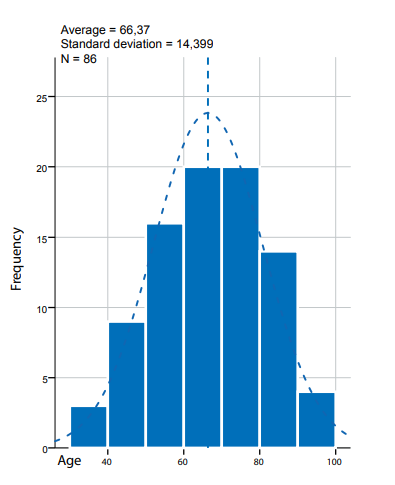
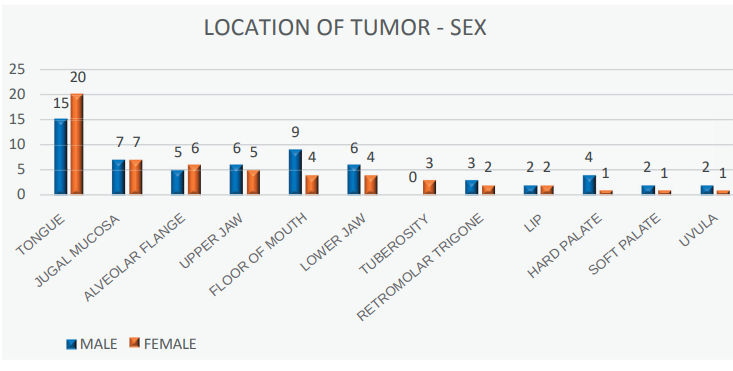
Results: Our sample has been made up of 46 men and 40 women. All of them suffer OSCC and have an average age of 66 years ± 14.0 years (66.37; 95% CI). Most of the patients in the sample have been from 60 to 80 years. The most relevant risk factors as predictors of this disease have been tobacco and alcohol. The most common places for oral carcinoma have been the tongue, the jugal mucosa and the floor of the mouth, in women the most frequent localization is in the tongue (57.14% vs 42.85%), the alveolar ridge (54.54% vs 45.45%) and maxillary tuberosity (100% vs 0%).
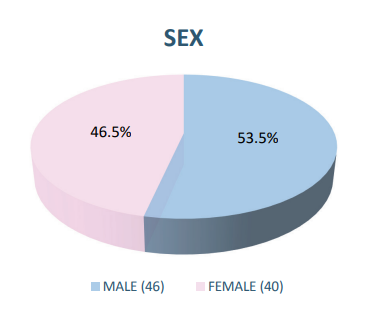
Conclusions: The profile of the patient suffering from oral cancer is beginning to change toward younger populations, finding it more often in women. The youngest patient with OSCC was 35 years old. Men continue to present more OSCC cases (53.5%), but women are approaching OSCC prevalence, and in some locations, they are already ahead. Risk factors such as tobacco and alcohol are shown to be positive predictors of oral cancer risk.
Oral cancer involves all topographic areas of the oral cavity as well as the lip. According to the World Health Organization (WHO) the global incidence is 4 cases per 100,000 inhabitants1, oral squamous cell carcinoma (OSCC) being the most common cancer of malignant tumours of the oral cavity2. representing 90% of cancers of the maxillofacial area. Cancers of the oral2 cavity and oropharynx are ranked sixth worldwide4, with Asian countries having the highest incidence of this type of tumours5. In Spain, the Spanish Network of Cancer Registries (REDECAN) estimates that approximately 277,394 new cancer cases have been diagnosed in 2020, with values very close to those of 2019. In the case of oral cavity and pharyngeal cancers incidence in Spain (2020) it has been 8.6 thousand cases6.
Oral and lip carcinoma presents a multifactorial etiology, being considered, among others, abusive alcohol and tobacco habits, areca nut consumption and human papillomavirus (HPV) infection, as risk factors for suffering OSCC3. Other factors that have been proposed as possible OSCC etiology are poor oral hygiene, genetic predisposition, nutritional deficiency, greater genomic alteration and chronic inflammation7. The most frequent OSCC locations are the oropharynx and the oral cavity8, with the tongue being the most frequent sublocalization in the oral cavity4.
The objective of this study was to review the profile of the patient presenting oral cancer related to sex and age, and to study the possible etiopathogenic factors related to its appearance.
An observational, descriptive and retrospective study was carried out on patients with oral cancer treated in the Oral and Maxillofacial Surgery Service of the Ramon y Cajal University Hospital in the period between 2004 and 2020. This study has been approved by the ethics and research committee of the aforementioned hospital. The data processing has been carried out at all times in accordance with the provisions of Law 3/2018 (Protection of Personal Data and Guarantee of Digital Rights Law) and the research team will undertake not to reidentify the patients once the data for the study has been obtained. The fieldwork has consisted in analysing the profile of patients diagnosed with oral cancer in the aforementioned hospital centre, who were older than 18 years and in those who appear to be recorded in their clinical history.
The variables studied were:
- Sex: male-female.
- Age: it will be expressed in decades.
- Tobacco use: Less than or more than 20 cigarettes a day.
- Alcohol consumption: non or occasional drinker, chronic drinker.
- Location of injuries: the following locations, listed in the tenth revision of the International Code of Diseases (ICD-10)9, have been included:
– Mobile portion of the tongue (C02.0-C02.3,C02.8 and C02.9).
– Floor of mouth in all its locations (C04.0,C04.1, C04.8 and C04.9).
– Gums in all its locations (C03.0, C03.1 and CO3.9).
– Lips in all locations (C00.0-C00.9, C43.0 y C44.0)
– Jugal mucosa (C06.0).
– Vestibule (C06-1).
– Hard palate (C05.0 and C05.9).
– Retromolar trigone (C06.2). - Selection of study population:
– Inclusion / Exclusion Criteria:
Inclusion criteria: Medical records of: - – Medical records from 2004 to 2020.
- – Sex (woman or man).
- – Patients older than 18 years.
- – Patients who have suffered or suffer from a tumour process in the oral cavity.
- – Records that reflect the patient’s smoking and alcohol habits.
Exclusions criteria: Medical records of:
- Pati ents younger than 18 years.
- Medical records prior to 2004.
- Patients who have not suffered or suffer from a tumour process in the oral cavity.
- Incomplete medical records regarding our study data.
The statistical analysis has been carried out using the computer application: IBM-SPSS Stati sti cs version 25 (IBM Corp. Released 2017. IBM SPSS Statistics v 25.0 for Windows).
The stati sti cal techniques and tests used were:
- The descripti ve of qualitati ve variables with frequencies and percentages tables (sex, lesions location).
- The quantitative variable age, has been described by the usual tools (a) of centrality: Mean and median; and (b) of variability: Observed range, standard deviation, minimum and maximum.
- Univariate binary logistic regression models were used to analyse the predictive capacity of the factors with respect to the dependent study variable (cancer). The variables are age, sex, tobacco, alcohol.
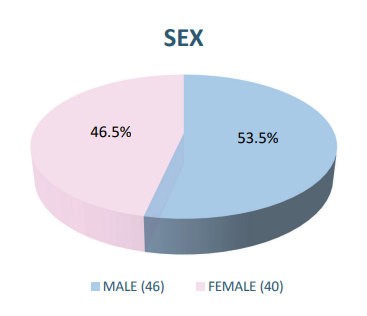
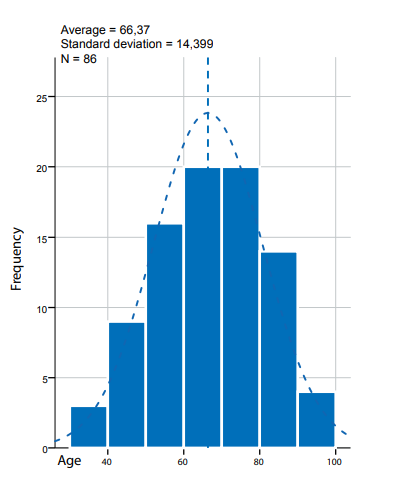
Our sample consisted of 86 pati ents, all of them with OSCC. We have reviewed 350 medical histories and excluded 264 histories due to lack of relevant information for our study. The pati ents of the sample were between 35 years the youngest and 95 years the oldest pati ent. The majority were between 60 to 80 years and 34% of the sample have been pati ents < 60 years. The distributi on by age range showed a negative asymmetry, with average age of 66 years ± 14.0 years (66.37 years; 95% CI) (Figure 1). Regarding sex, our results show that there is a higher frequency of oral carcinomas in men with a percentage of 53.5% compared to 46.5% in the case of women (Figure 2).
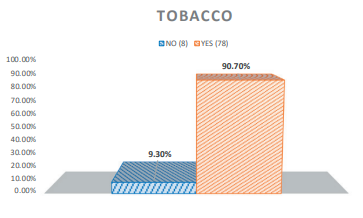
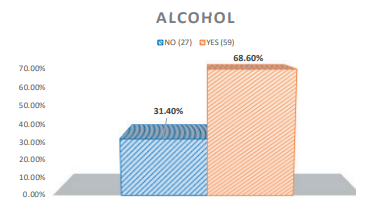
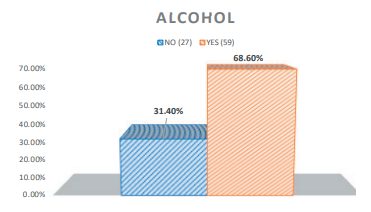
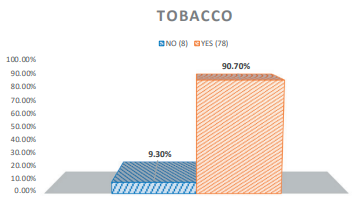
Data on tobacco and alcohol consumpti on of the patients in the sample are represented in Figure 3. 90.7% of the pati ents studied with OSCC smoked more than 20 cigarettes a day and 68.60% were chronic drinkers (Figures 3 and 4).
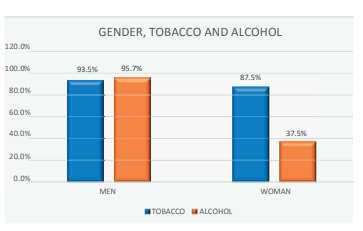
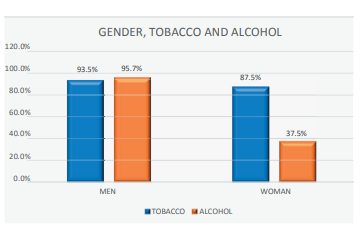
Analysing, the habits by sex it is observed that of the 46 men in the sample, 43 have smoking habits, that is, 93.5% smoke more than 20 cigarett es/day. Regarding the drinking habit there are 44 (95.7%) chronic drinkers in the case of women we see that of the 40 women in the sample, 35 (87.5%) have a smoking habit of more than 20 cigarettes/day and 15 (37.5%) are chronic drinkers (Figure 5).
There are practically no differences between tobacco and alcohol consumption in men.
Important diff erences have been found in women, with a greater consumpti on of tobacco compared to alcohol. This increase is represented by 50 percentage points more tobacco users than alcohol users among women. When comparing tobacco consumpti on between men and women, the diff erence was only 6 percentage points higher in men.
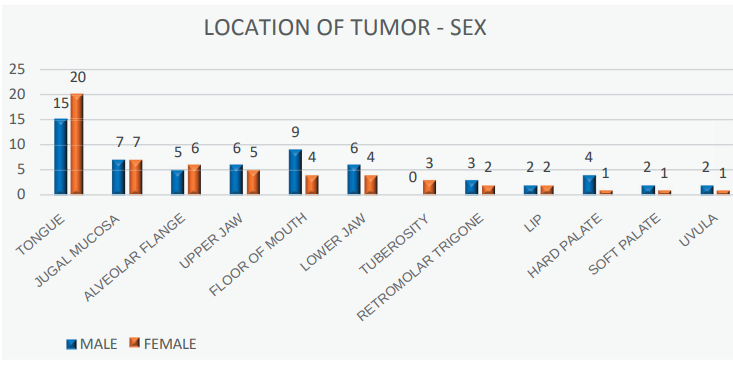
The most frequent locati on of OSCC has been in the tongue, where 35 of the 86 cancer cases (40.6%) have been located, followed by the jugal mucosa with 14 cases and fl oor of the mouth with 13 cases, similar prevalence (16.2% and 15.1% respecti vely).
Regarding sex and its relati onship with the locati on of the tumour, it has been observed that in most of the localizations the OSCC is more frequent in males, but they are equal in the yugal mucosa and the lip cases and it is already higher in the tongue in women, alveolar ridge and in the tuberosity of the maxilla (Figure 6).
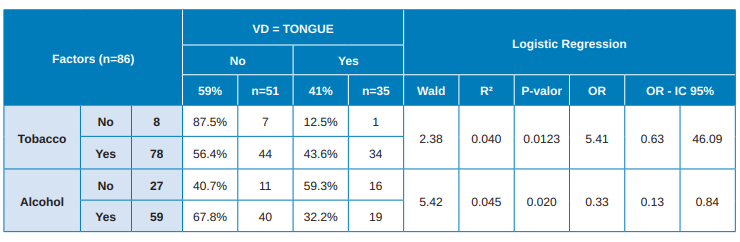
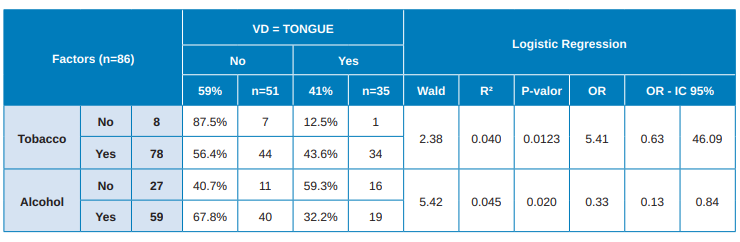
Tobacco appears in our stati sti cal study as a factor with a high predictive capacity for cancer (p<0.02). Alcohol alone appears with a lower predicti ve capacity (p<0.05). The table shows the logisti c regression analysis of the tongue in relati on to substance use, being the most frequent area of OSCC in this study.
The associati on of tobacco and alcohol in the same patient is shown as a highly predicti ve factor (p< 0.012).
According to the Spanish Society of Medical Oncology, up to the age of 80 men have a risk of developing a carcinoma of 40.9% and in the case of women, 27.0%.
But these figures increase as the population ages and at age 85 they represent values of 49.1% in men and 31.8% and 31.8% in women6, although we find cases in increasingly younger patients10,11. As seen in the sample of this study, although most patients were between 60 to 80 years, we must emphasize that 34% of the sample were patients < 60 years old and the youngest patient was only 35 years old, this being a smoker of more than 20 cigarettes a day and a chronic drinker. This patient developed an OSCC in the floor of the mouth. In this patient, the synergistic effect of both etiopathogenic factors was combined.
The average age of the patients in our study, 66.37 years, is very similar to the data obtained through the Tumour Registry of Madrid (RTMAD) 201912 in Madrid public hospitals where the average age was 66.2 years.
Regarding sex, men have presented the highest percentage of OSCC compared to women, although this trend is changing8,10,13. These results are very similar to those obtained in the study of cases registered in RTMAD12 where the majority were men with 55% (18,300 cases) compared to 45% (14,677 cases).
It is important to highlight the change in trend, which is reflected in tongue carcinoma, where already in this work is more prevalent in women, also occurs in the tuberosity of the maxilla and alveolar ridge, this data together with the approximation to equalize in frequency in the lip and jugal mucosa locations. Social evolutionism in the incorporation of women into habits that were previously almost exclusive to men is having clear consequences in an increase in prevalence in certain locations, as we have seen.
It is well established in multiple studies that due to tobacco and alcohol consumption there is a greater genetic alteration in the population with these habits that leads to tumour development and growth than in patients who do not have said habits, therefore, the combination of tobacco and alcohol determines an increased risk of developing OSCC. It is known that alcohol increases the permeability of the oral mucosa membrane which gives greater ability to the tobacco toxic chemicals to enter the epithelial membrane and trigger the OSCC14 mechanisms of genesis. With the limitations of a retrospective study, the high number of patients who smoke and drink in our research could explain this malignant transformation, being smokers of more than 20 cigarettes a day 90.7% and 68.6% chronic drinkers of the sample. Throughout history, there has been a change of the trend in the profile of patients with oral cancer, both in sex and age. Although statistics show that middle and advanced age men constitute the most frequent profile of pati ents with oral cancer, there is a clear increase in women11,15 and in young people with this disease16.
This may be due to the change in habits of women regarding tobacco, which has increased considerably as well as the increase in the number of annual deaths of women due to tobacco. 2019-2020 has been the year with the lowest fi gure in the history of tobacco consumpti on. If we compare it to 2017 we see a slight decrease of 1.5 percentage points. Even so, the fi gure remains excessively high with 39.4% of people who have smoked in the last 12 months in 2019 being practi cally the same between sexes and also at early ages17. In addition, alcohol is the most consumed substance in Spain that presents a prevalence of morbidity and mortality in the 20 to 39 age group and is responsible for causing 200 diseases, including cancer18. It can be observed that women from 2006 to 2017 have been approaching men regarding drinking habits, especially in the ages between 25 and 64 years17.
It is important to note that smoking pati ents are six ti mes more likely to develop oral mucosa cancer according to literature19. In the present work we agree with these statements, mainly in the localizati on in the tongue with a fi gure of 5.41% ti mes more likely among smokers. In the case of drinkers, in this study a percentage of 95.7% was found in men and 37.5% in women.
These values are higher than the data obtained in alcohol, drugs and other addicti ons survey in people over 64 years old (Survey on Alcohol, Drugs and other Addicti ons in the Elderly over 64 years of age “ESDAM”)17 in Spain, where in the last month, 67.7% of men and 30.9% of women are drinkers. This age group presents the characteristi c of having a greater daily consumpti on and less intensive consumpti on habit, compared to the young populati on. Consequently, alcohol makes the occurrence of cancer 2.4 times more likely in drinkers than non-drinkers19, and in this study it appears as a signifi cant factor in the likelihood of developing OSCC.
While anti -smoking laws and tobacco and alcohol cessation implementations are providing encouraging data, other habits are emerging such as the increase of e-cigarettes, hookahs and smokeless tobacco among young people. The cause of this increase could be poor awareness and lack of informati on about the harmful eff ects of this type of tobacco. In additi on, it has been possible to observe the evoluti onary process from 2017 to 2020 that has had an upward trend, going from 8.8% to 10.5% and being very frequent in women the use of e-cigarettes in the age group of 45-54 years20.
It is worth noting the change in trend regarding the involvement of women in the prevalence of cancer, in this study in the case of the tongue, alveolar ridge and in the tuberosity of the maxilla, women have suffered more frequently OSCC, being the tongue the area where more cases of this neoplasm have occurred.
We agree with the study carried out by Sundermann et al.,11 which analysed risk factors, tumour location and sex, resulting in a higher rate of OSCC cases in the tongue and jaw in women. The global study conducted by Ng et al.,21 analysing tongue cancer in relation to age and sex, concluded that tongue cancer had increased over the age of 40 years in the 22 countries analysed, he especially observed an increase in younger white women, but he could not globally determine the frequency between genders. Although the study was carried out until 2012 in some countries, it was already marking the future evolution of lingual OSCC in women.
The general data of this study show that oral cancer is more prevalent in men (53.5%), but there are locations such as the tongue, alveolar ridge and maxillary tuberosity where it appears most frequently in women.
- The appearance of patients with OSCC in the 30s age, and finding 34% of patients with OSCC under 60 years of age, should alert us to the importance of performing a thorough oral examination in all patients, regardless of their age.
- Tobacco alone, and especially the synergy of tobacco and alcohol, may be positive predictors of oral carcinoma risk.
This work is part of a larger study that involves a followup, but has been carried out in the middle of COVID-19 and the stay in the hospital was limited.
We have found that the medical records do not show information about the oral treatments that the patient has had, nor the traumatic factors associated with poorly adjusted prosthesis or other chronic irritant or inflammatory factors. this could be very useful when analysing the
I thank Dr. Somacarrera in a special way for his dedication and patience, to Dr. Steel for his support and, I value the opportunity to learn from two great health and teaching professionals. In addition, I appreciate the collaboration of Dr. Martin and Dr. Cardenas in this research process.


Suarez Beke, Ana Paula
Master of Advanced Oral Implantology. PhD student in Biomedicine and Health Sciences, European University of Madrid.
Somacarrera Pérez, Maria Luisa
Dentistry Professor. European University of Madrid.
Martin Carreras-Presas, Carmen
Dentistry Professor. European University of Madrid.
Cardenas Serres, Cristina
Intern. Oral and Maxillofacial Surgery Service, University Hospital Ramon y Cajal, Madrid
Acero Sanz, Julio
Head of Services Oral and Maxillofacial Surgery Service, Ramon y Cajal University Hospitals and Puerta de Hierro. Professor, University of Alcala, Madrid.
Indexed in:
– IME (Spanish Medical Index)
– IBECS (database)
– LATINDEX (Regional Online Information System)
– GOOGLE ACADEMIC