Revisión bibliográfica
Benito López P, Ruiz Rincón M, Ouazzani Touhami M, Bazal Bonelli S, Sánchez-Labrador L. Supervivencia de implantes cortos y extracortos frente a implantes de longitud estándar. Cient. Dent. 2024; 21; 2; 67-74.
Supervivencia de implantes cortos y extracortos frente a implantes de longitud estándar
Resumen
Introducción: El uso de implantes dentales cortos y extracortos permite aprovechar el hueso alveolar residual, evitando técnicas de aumento óseo. La evidencia actual sugiere que los implantes cortos y extracortos pueden tener una supervivencia similar a los implantes de longitud estándar. El objetivo de esta revisión es determinar la tasa de supervivencia, pérdida ósea marginal y aparición de complicaciones de los implantes cortos y extracortos en comparación con los implantes de longitud estándar.
Métodos: Se realizó una búsqueda bibliográfica en las bases de datos MEDLINE/PubMed, Web of Science y SCOPUS. Las palabras clave empleadas fueron “Short implant” AND “extra” AND “dental”.
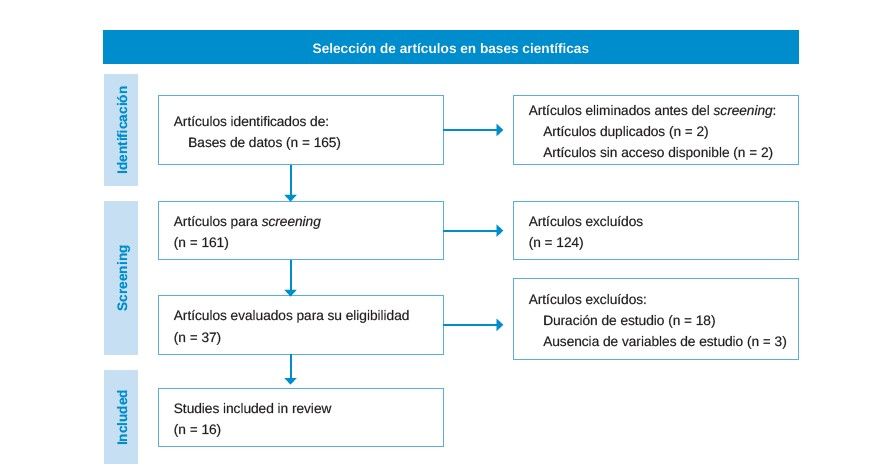
Resultados: El proceso de búsqueda dio como resultado 165 artículos de los cuales, aplicando los criterios de inclusión y exclusión, se incluyeron finalmente 15. El total de pacientes fue de 979 a los que se les colocaron 1753 implantes (574 cortos, 294 extra cortos y 887 convencionales), con un seguimiento de 3 a 10 años. La tasa de supervivencia fue del 83,34%–100% en implantes extracortos/cortos, y del 90%-100% en estándar. Se reportaron 246 complicaciones; 63% producidas en implantes estándar y el 37% en implantes cortos y extracortos.
Conclusiones: La colocación de implantes cortos parece tener una supervivencia y una pérdida ósea marginal similar, así como, menores complicaciones biológicas que los implantes de longitud estándar. Son necesarios más ensayos clínicos aleatorizados que comparen ambos tipos de implantes para obtener datos más robustos y de mayor evidencia.
Abstract
Survival of short and extra-short implants versus standardlength implants. Narrative review
Introduction: The use of short and extra-short dental implants makes it possible to take advantage of the residual alveolar bone, preventing bone augmentation techniques. Current evidence suggests that short and extra-short implants may have similar survival rates to standard length implants. The objective of this review is to determine the survival rate, marginal bone loss and occurrence of complications of short and extra-short implants compared to standard length implants.
Methods: A bibliographic search was performed in the MEDLINE/PubMed, Web of Science and SCOPUS databases. The keywords used were “Short implant” AND “extra” AND “dental”
Results: The search process resulted in 165 articles of which, applying the inclusion and exclusion criteria, 15 were finally included. The total number of patients was 979 in whom 1753 implants were placed (574 short, 294 extra short and 887 conventional), with a follow-up of 3 to 10 years. The survival rate was 83.34%–100% in extracortos/short implants, and 90%–100% in standard implants. 246 complications were reported; 63% produced in standard implants and 37% in short and extra-short implants.
Conclusions: The placement of short implants seems to have similar survival and marginal bone loss, as well as fewer biological complications than standard length implants. More randomized clinical trials are necessary that compare both types of implants to obtain more robust data and greater evidence.
Keywords: Short implants, Extra short implants, survival rate, marginal bone loss.
Palabras clave
Implantes cortos, Implantes extracortos, pérdida ósea marginal., Tasa de supervivencia
Introducción
La implantología es una de las especialidades odontológicas más demandadas por los pacientes en la actualidad. Ofrece numerosas ventajas frente a las prótesis removibles, como una mayor estabilidad, funcionalidad, estética y preservación del hueso remanente1. Por ello, se ha convertido en una de las primeras opciones terapéuticas cuando existen ausencias de uno o varios dientes2.
No obstante, la colocación de implantes está condicionada por la cantidad y calidad ósea, que pueden verse comprometidas por diversos factores, entre los que destacan la pérdida dentaria, la enfermedad periodontal, los traumatismos dento-maxilares, las infecciones, las reabsorciones, las anomalías congénitas y las intervenciones y cirugías dentales previas3.
Todo esto puede suponer que los pacientes presenten una cantidad de hueso insuficiente para la colocación de implantes de longitudes estándar. La longitud estándar, con respecto a los implantes dentales, se ha considerado clásicamente de 10 o más milímetros4. Aunque, actualmente la literatura considera a los implantes de medida estándar aquellos entre los 8 y los 10 mm, debido a que son las longitudes más semejantes a las raíces 5-6.
En casos de insuficiente disponibilidad ósea, existen diferentes alternativas terapéuticas entre las que se encuentran los injertos óseos7, las distracciones osteogénicas8, los implantes cigomáticos9 o los implantes basales10. Sin embargo, estos procedimientos son complejos, invasivos, costosos y prolongados en el tiempo, pudiendo conllevar mayores riesgos y complicaciones quirúrgicas1.
Por ello, el uso de implantes dentales cortos (6-8 mm) y extracortos (<6 mm)6, permiten aprovechar el hueso alveolar residual, evitando recurrir a técnicas de aumento óseo. Además, permiten simplificar el tratamiento reduciendo tiempos y costes, y permitiendo una terapia más cómoda para el paciente2.
La evidencia científica actual sugiere que los implantes cortos y extracortos pueden tener una supervivencia y un éxito similares, o incluso mayores a los implantes de longitud estándar, siempre que se establezcan unos protocolos correctos en cuanto al diseño, selección, colocación, carga y mantenimiento de los mismos11.
Por tanto, el objetivo de la presente revisión es determinar la tasa de supervivencia, la pérdida ósea marginal y la aparición de complicaciones de los implantes cortos y extracortos en comparación con los implantes de longitud estándar.
Bibliografía
Polis C, Domingo M, López J, et al. Implantes dentales cortos en la rehabilitación de los maxilares atróficos: puesta al día. Av Perio. 2017; 29(1): 23-30.
Anitua E. Implantes extracortos en mandíbulas con extrema reabsorción vertical: serie de casos. Acta Odontológica Colombiana. 2019;9(1):93–96.
Arlin ML. Short dental implants as a treatment option: results from an observational study in a single private practice. Int J Oral Maxillofac Implants. 2006;21(5):769–776.
Atieh MA, Zadeh H, Stanford CM, et al. Survival of short dental implants for treatment of posterior partial edentulism: a systematic review. Int J Oral Maxillofac Implants. 2012;27(6):1323–1331.
Anitua E, Piñas L, Murias-Freijo A, et al. Rehabilitation of Atrophied Low-Density Posterior Maxilla by Implant-Supported Prosthesis. J Craniofac Surg. 2016;27(1):e1–37.
- Al-Johany SS, Al Amri MD, Alsaeed S, et al. Dental Implant Length and Diameter: A Proposed Classification Scheme. J Prosthodon. 2016;26(3):252–260.
Sghaireen MG, Shrivastava D, Alnusayri MO, et al. Bone Grafts in Dental Implant Management: A Narrative Review. Curr Pediatr Rev. 2022;19(1):15–20.
Marcantonio C, Nícoli LG, Pigossi SC, et al. Use of alveolar distraction osteogenesis for anterior maxillary defect reconstruction. J Indian Soc Periodontol. 2019;23(4):381–386.
Sáez-Alcaide LM, Cortés-Bretón-Brinkmann J, Sánchez-Labrador L, et al. Patient-reported outcomes in patients with severe maxillary bone atrophy restored with zygomatic implant-supported complete dental prostheses: a systematic review. Act Odont Scand. 2022;5(80):1–11.
Verma S, Anuradha M, Babaji H, et al. Assessment of basal implants in compromised ridges. J Family Med Prim Care. 2020;9(4):2067.
Bitinas D, Bardijevskyt G. Short implants without bone augmentation vs. long implants with bone augmentation: systematic review and meta-analysis. Aust Dent J. 2021;66 Suppl 1:S71-S81.
Felice P, Barausse C, Pistilli R, et al. Five-year results from a randomised controlled trial comparing prostheses supported by 5-mm long implants or by longer implants in augmented bone in posterior atrophic edentulous jaws. Int J Oral Implantol (Berl). 2019;12(1):25–37.
Pohl V, Thoma DS, Sporniak-Tutak K, et al. Short dental implants (6 mm) versus long dental implants (11-15 mm) in combination with sinus floor elevation procedures: 3-year results from a multicentre, randomized, controlled clinical trial. J Clin Perio. 2017;44(4):438–445.
Bechara S, Kubilius R, Veronesi G, Pires JT, Shibli JA, Mangano FG. Short (6-mm) dental implants versus sinus floor elevation and placement of longer (≥10-mm) dental implants: a randomized controlled trial with a 3-year follow-up. Clin Oral Implants Res. 2016;28(9):1097–1107.
Estévez-Pérez D, Bustamante-Hernández N, Labaig-Rueda C, et al. Comparative Analysis of Peri-Implant Bone Loss in Extra-Short, Short, and Conventional Implants. A 3-Year Retrospective Study. Int J Environ Res Public Health. 2020;17(24):9278.
Guida L, Annunziata M, Esposito U, et al. 6-mm-short and 11-mm-long implants compared in the full-arch rehabilitation of the edentulous mandible: A 3-year multicenter randomized controlled trial. Clin Oral Implants Res. 2020;31(1):64-73.
Zadeh HH, Guljé F, Palmer PJ, et al. Marginal bone level and survival of short and standard-length implants after 3 years: An Open Multi-Center Randomized Controlled Clinical Trial. Clin Oral Imp Res. 2018;29(8):894–906.
Naenni N, Sahrmann P, Schmidlin PR, et al. Five-Year Survival of Short Single-Tooth Implants (6 mm): A Randomized Controlled Clinical Trial. J Dent Res. 2018;97(8):887–892.
Guljé FL, Raghoebar GM, Vissink A, et al. Single crowns in the resorbed posterior maxilla supported by either 11-mm implants combined with sinus floor elevation or 6-mm implants:A 5-year randomised controlled trial. Int J Oral Implantol (Berl). 2019;12(3):315–326.
Yang TC, Maeda Y, Gonda T. Biomechanical rationale for short implants in splinted restorations: an in vitro study.Int J Prosthodon. 2011;24(2):130–132.
Felice P, Cannizzaro G, Barausse C, et al. Short implants versus longer implants in vertically augmented posterior mandibles: a randomised controlled trial with 5-year after loading follow-up. Eur J Oral Implantol. 2014;7(4):359–369.
Guljé FL, Meijer HJA, Abrahamsson I, et al. Comparison of 6‐mm and 11‐mm dental implants in the posterior region supporting fixed dental prostheses: 5‐year results of an open multicenter randomized controlled trial. Clin Oral Implants Res. 2021;32(1):15–22
Heimes D, Becker P, Pabst A, et al. How does dental implant macrogeometry affect primary implant stability? A narrative review. Int J Implant Dent. 2023;9(1):20.
Jung RE, Al-Nawas B, Araujo M, et al. Group 1 ITI Consensus Report: The influence of implant length and design and medications on clinical and patient-reported outcomes. Clin Oral Impl Res. 2018;29(Suppl. 16):69–77.
Chrcanovic BR, Albrektsson T, Wennerberg A. Reasons for failures of oral implants. J Oral Rehab. 2014;41(6):443–476.
Sánchez-Torres A, Cercadillo-Ibarguren I, Moragón-Rodríguez M, et al. Retrospective cohort study on the influence of bone remodeling on marginal bone loss and Peri-implantitis around immediately loaded implants supporting complete-arch restorations. Int J Oral Maxillofac Implants. 2021;36(6):1165–1172.
Cruz RS, Lemos CAA, Batista VES, et al. Short implants versus longer implants with maxillary sinus lift. A systematic review and meta-analysis. Braz Oral Res. 2018;32:e86.
Koldsland OC, Scheie AA, Aass AM. Prevalence of peri-implantitis related to severity of the disease with different degrees of bone loss. JPeriodontol. 2010;81(2):231–238.
Matarazzo F, Sabóia-Gomes R, Alves BES, et al. Prevalence, extent and severity of peri-implant diseases. A cross-sectional study based on a university setting in Brazil. J Periodontal Res. 2018;53(5):910-915.
Caton JG, Armitage G, Berglundh T, et al. A new classification scheme for periodontal and peri‐implant diseases and conditions – Introduction and key changes from the 1999 classification. J Clin Periodontol. 2018;45(S20).
Azañón R, Martínez I, Ferrer J, et al. Pertinencia del uso de implantes dentales cortos en pacientes con atrofia ósea severa. Revisión de la literatura. Av Periodon Implantol. 2013;25(3):153–164
Cannizzaro G, Felice P, Ippolito DR, et al. Immediate loading of fixed cross-arch prostheses supported by flapless-placed 5 mm or 11.5 mm long implants: 5-year results from a randomised controlled trial. Eur J Oral Implantol. 2018;11(3):295–306.
Griffin TJ, Wai Ming Cheung. The use of short, wide implants in posterior areas with reduced bone height: a retrospective investigation. J Prosthet Dent. 2004;92(2):139-144.
Guljé FL, Raghoebar GM, Gareb B, et al. Single crowns in the posterior maxilla supported by either 11-mm long implants with sinus floor augmentation or by 6-mm long implants: A 10-year randomized controlled trial. Clin Oral Implants Res. 2024;35(1):89–100.
Ravidà A, Wang I-Ching, Barootchi S, et al. Meta-analysis of randomized clinical trials comparing clinical and patient-reported outcomes between extra-short (≤6 mm) and longer (≥10 mm) implants. J Clin Perio. 2018;46(1):118–142.
Rossi F, Botticelli D, Cesaretti G, et al. Use of short implants (6 mm) in a single-tooth replacement: a 5-year follow-up prospective randomized controlled multicenter clinical study. Clin Oral Implants Res. 2015;27(4):458–464.
Sahrmann P, Naenni N, Jung RE, et al. Ten-year performance of posterior 6-mm implants with single-tooth restorations: A randomized controlled trial. J Dent Res. 2023;102(9):1015–1021.
Taschieri S, Lolato A, Testori T, et al. Short dental implants as compared to maxillary sinus augmentation procedure for the rehabilitation of edentulous posterior maxilla: Three-year results of a randomized clinical study. Clin Implant Dent Rel Res. 2017;20(1):9–20.
Guida L, Bressan E, Cecoro G, et al. Short versus longer implants in sites without the need for bone augmentation: A systematic review and meta-analysis of Randomized Controlled Trials. Materials (Basel). 2022;15(9):3138.
Toti P, Marchionni S, Menchini-Fabris GB, et al. Surgical techniques used in the rehabilitation of partially edentulous patients with atrophic posterior mandibles: A systematic review and meta-analysis of randomized controlled clinical trials. J Craniomaxillofac Surg [Internet]. 2017;45(8):1236–1245.