
Original article
Influence of a cyanoacrylate-based adhesive on pain and healing at the palatal donor site after connective tissue graft harvesting: Preliminary results of a multicenter randomised clinical trial
Introduction: The use of cyanoacrylate has been proposed as an alternative in clot stabilization in the palatal donor site after harvesting connective tissue grafts. The main advantages are the reduction of postoperative pain perception and improved wound healing.
Methods: Preliminary results of a randomized clinical study are reported. 20 patients were divided into two groups: one in which sutures were used (control group and another where a cyanoacrylate-based tissue adhesive was applied (test group). Variables such as postoperative pain, healing, analgesic consumption, and patient willingness to undergo a similar procedure were compared.
Results: The cyanoacrylate group experienced less pain during the 14-day postoperative period compared to the control group, reflected in lower scores on the visual analogue scale. Furthermore, patients in the test group consumed fewer analgesics and showed a greater willingness to repeat the procedure, suggesting a better postoperative experience. As for healing, no differences were found between the two groups according to the modified early wound healing index assessed at 7 and 14 days.
Conclusions: Preliminary results suggest that cyanoacrylate is an effective alternative to sutures, with clear advantages in terms of pain reduction and patient comfort.
Key words: Cyanoacrylate; Connective tissue graft; Postoperative complications; Wound healing.
Periodontal plastic surgery is the treatment of choice for gingival recessions and mucogingival defects1,2. Connective tissue grafts (CTGs) are currently considered the gold standard for soft-tissue reconstruction because of their long-term stability and biocompatibility2. The technique most commonly used to harvest a CTG is that described by Zucchelli et al.3, which consists of harvesting a free gingival graft that is then de-epithelialised extraorally. Other methods of harvesting these grafts are available, such as the single-incision technique4, which are intended to minimise morbidity at the donor site. However, CTG harvesting always involves a donor site, usually on the palate, increasing the complexity of the procedure and patient discomfort during the postoperative period. During healing, this may lead to complications such as bleeding, pain, infection, or necrosis, mostly associated with failure to form a stable blood clot5-8. In addition to sutures, various haemostatic and wound-healing agents have been used to achieve this stabilisation, including cyanoacrylate-based adhesives8. The main properties of these tissue adhesives include their excellent haemostatic capacity, rapid adhesion to tissues, and potential bacteriostatic properties8. Previous studies indicate that the use of these agents to promote healing at the palatal donor site after CTG harvesting using different techniques is promising9,10. However, the literature on healing and tissue response at the palatal donor site after CTG harvesting using the single-incision technique remains limited. Therefore, the aim of the present study was to evaluate and compare the use of sutures and cyanoacrylate at the palatal donor site after CTG harvesting.
Study design
The present study was designed as a multicentre randomised controlled clinical trial. The research protocol was approved by the Ethics Committee of Hospital Clínico San Carlos in Madrid (23/744-EC_X), in accordance with the CONSORT guidelines, and was registered at ClinicalTrials.gov (NCT06116539). The study protocol complied with the 1975 Declaration of Helsinki. A sample size of 40 patients was calculated using G*Power® software (Heinrich Heine University Düsseldorf, Germany). The patients were divided into two groups. In the control group, the clot was stabilised using sutures, whereas in the test group, a cyanoacrylate-based tissue adhesive was used (PeriAcryl 90 HV; Glustitch, Delta, Canada). All patients were informed about and understood the aims of the study; they participated voluntarily after providing both verbal and written informed consent. The study was conducted at two private centres between January and September 2024. To be included in the sample, patients had to be candidates for mucogingival treatment requiring a CTG around teeth or implants. No age limit was set. Patients were excluded if they had systemic conditions or healing problems, were receiving bisphosphonate therapy, smoked more than 10 cigarettes per day, had previously undergone palatal graft harvesting at the same site, or had any contraindication to surgery.
Procedure
All procedures were performed by two calibrated operators (IFB, JLM). Once the patient had agreed to participate in the study and signed the informed consent form, they were randomly assigned to one of the groups. The randomisation sequence was computer-generated before the start of the study, and each participant was assigned to a group according to the order of enrolment.
Planning: sociodemographic data and general patient characteristics (age, sex, smoking status, systemic health, and medication) were recorded at the first visit.
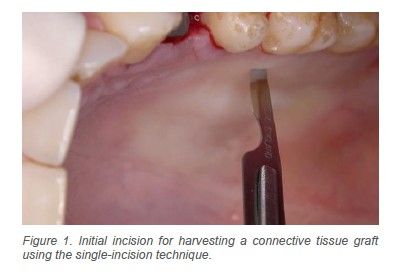
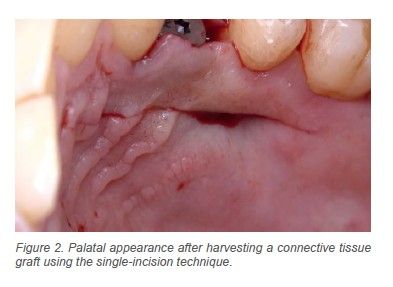
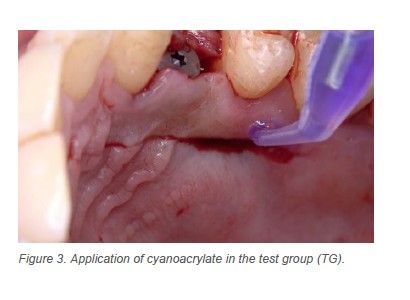
Surgical technique: The subepithelial connective tissue graft was harvested using the single-incision technique described by Hürzeler et al. in 19994. The first incision was made at full thickness, perpendicular to the palate and at least 2 mm from the probing depth on the palatal aspect of the adjacent teeth. A partial-thickness incision was then made parallel to the palatal epithelium to avoid fenestrations. The graft was harvested by means of a second partial-thickness incision parallel to the bone. In the control group, the clot was stabilised using 4-0 non-resorbable monofilament nylon sutures (Aragó, Barcelona, Spain), with double tooth-supported sutures4. In the test group, a cyanoacrylate-based tissue adhesive (PeriAcryl 90 HV; Glustitch, Delta, Canada) was applied according to the manufacturer’s instructions. The protocol followed in the test group is shown in Figures 1, 2, and 3.
Postoperative Care: Ibuprofen 600 mg was prescribed every 8 hours for the first 3 postoperative days. Thereafter, patients were advised to take it as needed. A 0.12% chlorhexidine mouthwash (Perio-Aid, Dentaid) was also prescribed for the first 2 weeks. Patients were scheduled at 7 and 14 days after surgery for removal of the palatal sutures and examination of the donor site.
Variables
Pain perceived by the patient was assessed using a visual analogue scale (VAS) on days 1, 2, 3, 4, 5, 6, 7, and 14. Healing of the donor site was visually assessed at 7 and 14 days using the modified Early Wound Healing Index (MEHI)11, which distinguishes the following five grades:
1. Complete flap closure with no fibrin line on the palate.
2. Complete flap closure with a fibrin line on the palate.
3. Complete flap closure with small fibrin clots on the palate.
4. Incomplete flap closure with partial necrosis of the palate involving less than 50% of the flap.
5. Incomplete flap closure with complete necrosis of the palatal tissue involving more than 50% of the flap.
Analgesic consumption and the occurrence of complications, such as bleeding or infection, were also recorded. Lastly, the patients’ willingness to undergo a second procedure requiring the use of palatal connective tissue grafts was assessed using an ordinal scale designed specifically for this study. The patients answered the following question: “Would you undergo this surgical procedure again, if necessary?” The response options were “Yes”, “Maybe”, and “Under no circumstances”.
Statistical analysis
The data collected during the study were analysed by calculating means and standard deviations (SD) using specialised statistical software (SPSS version 28.0, IBM Corp., Armonk, NY, USA).
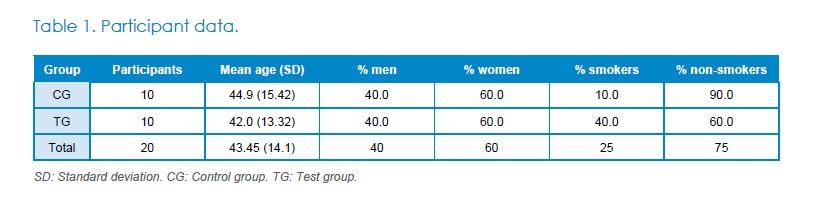
Preliminary results are presented for 20 patients who had completed the study to date, of whom 10 were in the control group (CG) and 10 were in the test group (TG). The demographics and general characteristics of the participants are listed in Table 1. The mean age was slightly higher in the control group (44.9 years) compared with the test group (42 years). The proportion of men and women was equal in both groups (40% men, 60% women). With regard to smoking, 10% of the patients in the control group were smokers, compared with 40% in the test group.
Graft dimensions
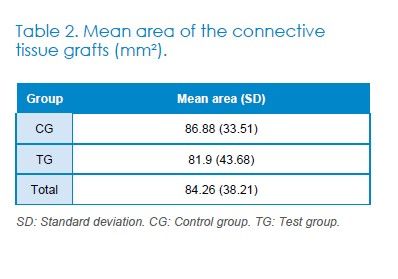
With regard to the dimensions of the CTGs harvested, Table 2 shows that the mean area was slightly larger in the control group (86.88 mm²) than in the test group (81.9 mm²).
Pain assessment
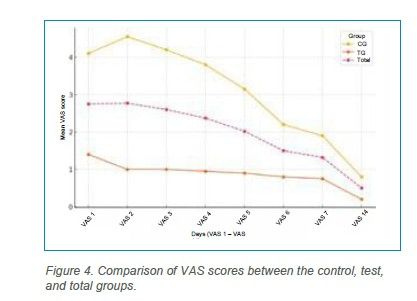
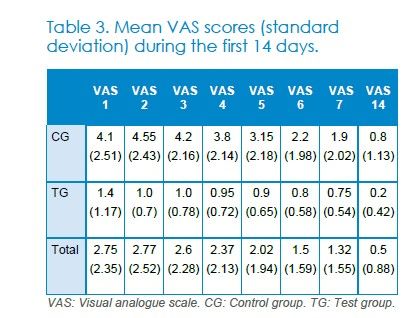
Pain perceived by the patients was assessed using the VAS during the first 14 postoperative days. The results, shown in Table 3, indicate that patients in the test group reported less pain than those in the control group throughout the follow-up period. On day 1, the mean pain score was 4.1 in the control group and only 1.4 in the test group. This trend continued throughout the 14 days, with residual pain being almost absent in the test group (0.2), compared with 0.8 in the control group. These results are shown graphically in Figure 4.
Donor site healing
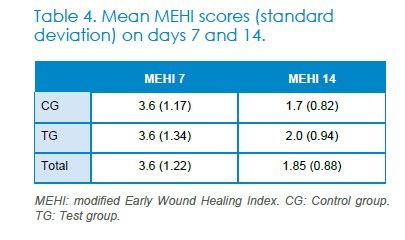
Healing was assessed using the MEHI on days 7 and 14, and the results are presented in Table 4. At 7 days, both groups had similar results (3.6 in both cases), indicating comparable initial healing. However, at 14 days, the control group showed faster improvement, with a MEHI score of 1.7 compared with 2.0 in the test group.
Analgesic consumption and postoperative complications
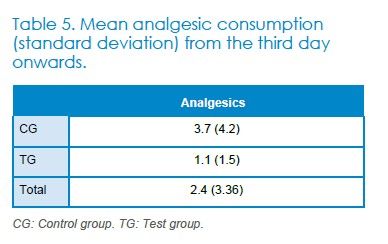
Analgesic consumption was lower in the test group. As shown in Table 5, patients in the control group consumed a mean of 3.7 doses of analgesics from the third postoperative day onwards, whereas consumption was lower in the test group, with a mean of 1.1 doses.
No postoperative complications were recorded in either group during the 14 days following the procedure.
Motivation to repeat the procedure
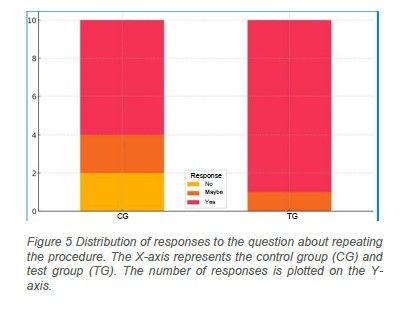
Regarding the patients’ willingness to undergo a second procedure requiring palatal graft harvesting, the data in Figure 5 show that patients in the test group would be more
The preliminary results of the present study confirm some of the trends reported in the literature regarding the use of cyanoacrylate to stabilise the clot at the palatal donor site, particularly in relation to reduced postoperative pain and analgesic consumption.
With regard to postoperative pain, patients in the cyanoacrylate group consistently reported lower pain levels than those in the suture group, in agreement with the results of similar studies9,10,12-15,18. Similar results were also found in studies in which free gingival grafts were harvested, with better outcomes in the cyanoacrylate group than in the suture group, as described by Karimi et al.19. These studies also reported that cyanoacrylate was effective in reducing pain during the early postoperative days. This is consistent with our data, in which the cyanoacrylate group showed a reduction in VAS scores from the first day onwards. This finding may be explained by the haemostatic and bacteriostatic properties of cyanoacrylate, which create a protective barrier and minimise exposure of the wound to oral irritants, as suggested by Tavelli et al.10,12. It is noteworthy that, in the present study, pain in the cyanoacrylate group was much lower not only during the first few days but also throughout the two-week period. This could indicate a more comfortable healing process for the patient, as has also been suggested in previous reviews¹⁶. This may be explained by the lower level of inflammation and more uniform distribution of neutrophils, lymphocytes, histiocytes, and eosinophils reported with cyanoacrylate-based adhesives17. These results support the use of haemostatic agents in this type of procedure, as concluded in the systematic review by Oliveira et al.20, in which all the agents studied produced better outcomes than spontaneous healing.
The lower analgesic consumption observed in the cyanoacrylate group in our study is also consistent with the existing literature10,12,13,18,19. Tavelli et al. (2018)12, Yilmaz et al. (2022)18and Parlak et al. (2023)15 reported a significant reduction in analgesic consumption in the cyanoacrylate groups compared with the suture groups, reflecting lower postoperative morbidity. In this trial, patients in the suture group consumed more than three times as many analgesics as those in the cyanoacrylate group, supporting the hypothesis that the reduced inflammation and wound protection provided by the tissue adhesive contribute to a more comfortable postoperative period.
With regard to healing, our study showed minimal differences between the two groups according to the MEHI, with results similar to those obtained by Castro-Gaspar et al. (2022)14; Stavropoulou et al. (2018)9; and Yilmaz et al. (2022)18. This finding contrasts slightly with some previous studies, such as that of Tavelli et al. (2018)12, which reported faster and more effective healing in the groups treated with cyanoacrylate. However, the difference may not be as marked in our preliminary results because of the sample size or the evaluation period, which was limited to two weeks. In any case, the MEHI values at 7 and 14 days were similar in both groups, suggesting that cyanoacrylate does not compromise initial wound healing.
Patients in the cyanoacrylate group were considerably more willing to undergo a similar procedure again than those in the suture group. This result has also been reported in studies such as that by Basma et al. (2022)13, in which patients treated with cyanoacrylate showed greater overall satisfaction and less perceived discomfort. Regarding complications such as bleeding and infection, no differences between the groups were observed in this preliminary assessment. This is also consistent with the studies cited above, in which cyanoacrylate was shown to be as safe as sutures in terms of complications9,13,14,18.
The preliminary results of the present study support the effectiveness of cyanoacrylate as an alternative to sutures for stabilising the clot at the palatal donor site after connective tissue graft harvesting. The benefits observed include reduced postoperative pain and analgesic consumption, with healing comparable to that achieved with sutures. These findings are consistent with the literature reviewed and suggest that cyanoacrylate may be a valid option for improving patients’ postoperative experience, although further studies with larger sample sizes will be required to confirm these long-term results.

Cárceles-Raga, Marc
Dentistry degree student. Universidad Alfonso X El Sabio (Madrid, Spain).
Fernández-Baca, Ignacio
DDS, MSc. Master’s degree in Oral Surgery, Implantology and Periodontology. Universidad Alfonso X El Sabio (Madrid, Spain).
Mascaró Sintes, María
DDS, MSc. Master’s degree in Oral Surgery, Implantology and Periodontology. Universidad Alfonso X El Sabio (Madrid, Spain).
Sánchez Santos, Juan
DDS, MSc. Master’s degree in Oral Surgery, Implantology and Periodontology. Universidad Alfonso X El Sabio (Madrid, Spain).
López-Malla Matute, Joaquín
PhD. DDS, MSc. Master’s degree in Oral Surgery, Implantology and Periodontology. Universidad Alfonso X El Sabio (Madrid, Spain).
Correspondence:
Ignacio Fernández-Baca.
Baca Estudio Dental
Pasillo del Matadero, 12. 29002 Málaga